|
* * * * * * * * * * * * * * * * * * * * * * * * * * * * * * * * * * * * * * *
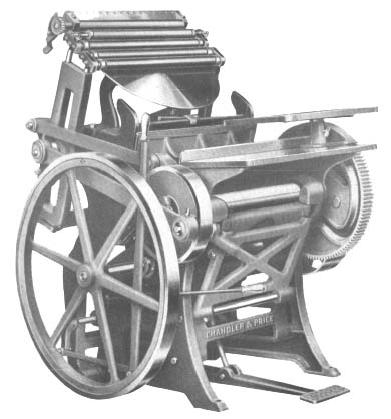
The Chandler & Price Company was founded about 1881 in Cleveland, Ohio, by Harrison T. Chandler and William H. Price. In 1884 they introduced - what was to become - their famous jobber, which was basically a copy of George P. Gordon's popular Franklin 'old style' jobbing press. In 1901 the Cleveland Company purchased the ailing Gordon Press Works and the right to use the name "Gordon". They continued operating the Rahway (N.J.) plant under the Gordon name for a short time before moving to their Cleveland factory. Ten years later they introduced their 'New Series,' a more sturdily constructed machine. The New Series can be identified quite readily by the straight flywheel spokes instead of the curved 'S ' shaped ones of earlier models. They were also constructed more solidly throughout using a box pattern with deep inward-facing flanges, were somewhat lower in height for operator convenience, had a smaller diameter flywheel and the roller saddle-rods and springs were fully enclosed in the roller arm frames. This New Series was painted a dark steel colour, without striping or other ornamentation, giving it a distinctive appearance.
The Miller Company manufactured an automatic feeder for the C.& P. in 1913 for a number of years although it appears to have not been overly popular. The Brandtjen & Kluge Co. also introduced their automatic feeder in 1919 which could be attached to some models. During the 1930's, C.& P. installed their own "Rice" feeders.
In 1930, it was said, that over 90% of the platen presses in use in the U.S.A. were products of the Cleveland company. They also made the 6½" x 10" Pilot hand press and a small cylinder press.
The growing dominance of offset printing, after World War II, sounded the death knell for C.& P. and the last platen presses, the 14½" x 22", were made in 1964.
In 1979, printers were shocked when C&P notified the Dept. of Health, Education and Welfare that their presses, due to advanced age, were unsafe for school use. Despite protests from printers, many of the presses were scrapped.
Picture and details ex ATF catalogue, 1912
* pictured
* * * * * * * * * * * * * * * * * * * * * * * * * * * * * * * * * * * * * * * * * *
|
|